Two Days

It is one in the morning on December 29 and I’m sitting quietly in the corner of an emergency vet hospital one and a half hours from home. It’s the closest emergency and specialist centre to me and I’d rather not be here but H, my cat, has deteriorated over the last few days and I cannot just hope for the best.

A few hours ago, G called out to me from another room. “I love you more,” he said, as I was googling respiratory distress and calling the emergency vet for advice. “Yeah?” I shouted back. “But do you love me enough?”

“What do you mean, enough?” he asked, realising our banter had shifted.

“I’m going to take Hunter to the emergency vet,” I said. “You can stay here.”

I heard the familiar crunch of styrofoam as he hauled himself out of the beanbag in the lounge room before coming to the dining table where I sat staring at the computer.

“No, I can’t,” he said. “You know I can’t.”

So at 10.15pm we piled into the car with the cat whose breathing was shallow and rapid, nostrils flaring.

***

A year ago, I almost succeeded in burning down the house. Not in the Talking Heads way, but rather in the way that I’d spent until near midnight on Christmas Eve cooking and preparing for the following day. After wiping everything down, cleaning the stove top, and placing the wooden chopping board on the stove for the following day’s prep, I stumbled into bed.

A couple of hours later, I woke to a strange, distant beeping sound. Weird, I thought in my sleepy haze, that sounds like a smoke alarm. It took a moment to process as my brain registered the noise; the far-away sound transitioning from a flat battery beep to a genuine, urgent, emergency beep.

Our house had only one smoke detector which, months earlier, had fallen out of the cement sheet ceiling so I’d placed it on top of a bookcase in the family room just down the hall from our bedroom. I moved slowly in the dark, assuming the smoke detector had failed, and felt my way along the bedroom wall to the sliding door before shuffling through a small gap into the hallway.

I opened the door at the end of the hall into the family room and switched on the light. Thick smoke obscured anything more than a few feet in front of me.

The cats, my God, where were the cats?

Edith darted immediately between my legs into the hall that was now beginning to fill with smoke. I ran back to the bedroom, woke G in case we needed to evacuate, and said I had to go find Hunter. I coughed my way through the smoke into the kitchen to attempt to identify where the fire was. But there was no fire. Just thick, heavy smoke in every room. I found H and hurried him into the bedroom where G was up and trying to come out to help. “Go back, go back into the bedroom,” I said. “There is no fire. I have to figure out what is going on.”

I wrapped a wet washcloth around my face to reduce the amount of smoke I was inhaling–we hadn’t yet begun to wear N95 masks so I didn’t have one readily available–and I knew from my workplace fire training that any damp, thick cloth would help filter the smoke. I walked from room to room opening windows, switching on fans and opening doors but could not find the source of the smoke.

Back in the kitchen, standing in front of the stove, I heard the familiar crackle and pop of wood as it heated and burned. Then I looked at the chopping board. I’d used it all day, washed it many times, and it had been waterlogged when I’d left it on top of the clean stove. Now, it was dry and beginning to curl at the edges. I grabbed it with an oven mitt, shoved it into the sink and doused it in water. On the underside was a perfect, charred circle where the hotplate had been slowly scorching it for hours. Eventually, I worked out that as I’d cleaned the stove and wiped the knobs, I must have flicked one ever so slightly into the on position. Just on low. Just enough that it heated the chopping board. The water had kept the board cool enough not to burn but instead, smoke profusely for hours, and now that most of the water had evaporated, it was dry and ready to burst into flames. It took hours to clear the house of smoke and even weeks later, if the air was very still, you could still catch a faint whiff of it.

Over the next 24 hours, Hunter’s breathing became loud and scratchy. The day after Christmas is known as Boxing Day, here. Boxing Day is a Public Holiday in Australia, and I called my vet, expecting an answering machine message that would advise me of their holiday opening hours. Instead, a person answered. And although there was only half an hour until closing time, they could fit H in. Did I want to bring him down? It’s a Public Holiday, though, they said, and an emergency appointment. Was I ok with both the extra charges? Yes, sure, I said. Whatever he needs.

I took H to the vet for raspy breathing and suspected smoke inhalation. One of his eyebrows was singed off and I guessed he had jumped up onto the counter to investigate, inhaling lungfuls of the heavy smoke. He’d always had a slight snore but in the 24 hours after the smoke event, his snore escalated to something else.

When I arrived and they listened to his chest, they wanted to perform an x-ray; a procedure which would require the vet and a nurse to stay back past closing time. Would I be ok with additional charges? Yes, sure, I said. Whatever he needs.

When I first adopted H, I used to smoke–inside–and although I quit many years ago, I have been paranoid ever since that I’ve given him lung cancer, in much the same way that I am sure I gave G blood cancer.

Nine hundred dollars later, we went home. Just monitor him, they said, and see if it settles down.

***

It didn’t settle down, so for the last 12 months, he’s had various treatments and investigations including blood tests, a specialist cardiology appointment and ultrasound of his heart, antibiotics, steroids and other medication. The final consensus has been “asthma” for which he has been prescribed an inhaler but I (not a vet) disagree with the consensus. Yes, he had been coughing. And the inhaler has eliminated the coughing. But there are other things, too. A loss of his higher register voice over a period of years. A new struggle to swallow and a choking/gagging noise when he eats. Vomiting. The high-pitched stridor in his throat as he inhales, that only I can hear when he rests his neck on my ear as we are laying down watching TV. At the vet, he is too stressed, too anxious, and too growly for them to hear what I hear.

Instead, those additional symptoms point to some type of laryngeal paralysis which is getting worse. He is booked in with the internal medicine specialist on January 18 for a scope in his nose and throat to identify any potential blockages. But the last few days of heat at 35 degrees Celsius saw his breathing rate double from 30 breaths per minute to 60 and to become more laboured. His breaths have been shallow or gasping and neither his steroid inhaler nor the emergency Ventolin salbutamol has helped.

G thinks I have hypochondria by proxy with the cat. And while I do have severe health anxiety and some of it may be transferred, I know there is something very wrong with his respiratory system and if he suffocates at home through my lack of action when a vet visit could have saved him, I will never forgive myself. H has outlasted all my relationships to date; at almost 12 years old, he has been with me through several heartbreaks, interstate moves, and has not faltered in his devotion to me from the very first moment I opened the cage door at the pet shop and he climbed into the crook of my neck. G is catching him in the longevity stakes, of course, and will eventually overtake him but I had intended to have H around for at least another five years before he breaks my heart.

***

As I wait, a man brings his elderly German Shepherd in. I catch snippets of his explanation to the nurse who is triaging the late-night attendees. Christmas Day, a whole roast chicken. Vomiting. Restless. Won’t sit down/lie down. Strange because. Osteoarthritis. I know that cooked chicken bones are terrible for dogs’ tummies and begin to worry for this dog that looks like the one I’m minding for 12 months. They take the man and his German Shepherd through to the back. Hunter has been under observation for almost two hours and no-one has come to give me any news. An hour later, the man comes out from the rooms in the back without his German Shepherd. I can hear him at the reception desk. He is sniffling. Crying. He makes a phone call I can’t hear. And I know then, that he won’t be taking his dog home. I begin to panic that I may not be taking Hunter home, either.

There is no sadder place than an emergency vet at two am in the holidays, except, perhaps for a hospital. And I’ve seen my share of those, too.

Another couple of hours pass, and they call me into the room. They ask why I brought H in tonight, and I explain the history of his breathing and investigative testing over the last 12 months, his current treatment, and the deterioration over the past three days.

“I can’t find anything wrong with him now,” the vet says. “His respiratory rate is normal, he is not in any distress–except perhaps some anxiety at being here–and all his other vital signs are good.”

This should be good news. Instead, I am only convinced that everyone except me is missing something while also knowing this is only going to further G’s belief that I’m making up symptoms the cat does not have.

We drive home, or rather, G drives us home and we fall into bed as the clock ticks over to five am.

***

At 8.30 am my alarm goes off. I have a doctor’s appointment at 9.40 am. I’ve had three and a half hours’ sleep and am starting to feel the effects of the covid booster that I had the afternoon before. I cannot tell if my headache is from the vaccine or lack of sleep. If the buzzing in my body is the vaccine or lack of sleep. If the nausea is the vaccine or lack of sleep. But I am starting to feel like death.

I go to the doctor and forget why I made the appointment so I end up discussing the headaches which are coming more frequently now than ever before. They could be hormonal, I say. Or they could be stress related. I list all of the reasons I could be experiencing frequent headaches but I never mention brain cancer. And neither does she. Where are the headaches located? she asks, and I motion across my forehead. At the front? she confirms. Yes. And do they get worse if you tip your head forward? Yes, I say. I can then get a shooting pain behind my eyes that takes a minute or two to recede when I lift my head again.

“Aspirin,” she says. “I’m going to give you a specific dose of aspirin to take every day for a week. I think they are tension headaches. Come back next week.”

I ask her to reprint my referral to the gastroenterologist that I’ve misplaced so that I can have my low iron levels investigated. And I check that I do not need a referral for a mammogram, that I can just book in through the breast screening program. Then, I go home to bed.

By lunchtime, I cannot sleep any more but feel awful. G feels wretched, too. And we are not sure if it’s from staying up all night or the vaccine. Or both. He says he feels hot, but when we take his temperature, it is normal. Several hours later, when I start to feel chilled, though I wouldn’t say feverish, I take my own temperature: 37.8 degrees Celsius, a mild fever. I take two Tylenol, have a warm shower, and go to bed.

***

Christmas has been a difficult time for me for 27 years and I ponder whether it is my own anxiety that ensures I add more traumatic events to the list each Christmas. Is it my attitude to this time of year that makes it more challenging, or is it the subconscious memory of terrible events that determine my attitude? For years, I worked on Christmas to avoid it altogether. Two nights ago, I took H to the emergency vet, believing he may be close to death. Today, he has been chasing the other cat around the house the same as he always does. Did I imagine it? Was his breathing really problematic or was it simply my fear that made it appear so? Will I believe anyone telling me there is nothing wrong with him or will I always think they are wrong? Are H’s perceived breathing problems a metaphor for my life? Perhaps, I am choking. And all we can do is keep breathing.

This world of words and pictures and music is a strange one. Everything I say here is true. Has always been true. And yet, it can never be the whole truth. I cannot write every thought I have, describe every interaction, post every photo or memory. That is to say, it is not a complete picture of my life. Only what I choose to share. But does that mean that what I don’t share can never be known? I’m not so sure. Quantum entanglement, while only in the initial stages of scientific exploration and understanding, possibly, probably shares more information and secrets than we will ever know.

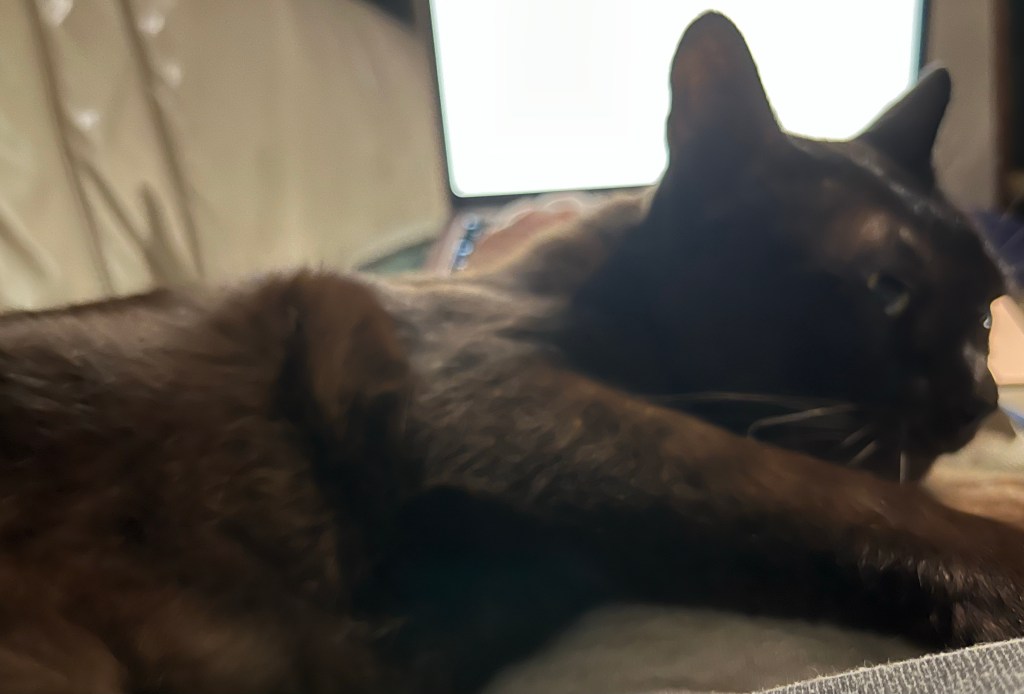
Today, I feel better. There is no headache (a miracle) although I’ve not yet taken any aspirin. And there is no strange buzzing in my body. No nausea and no fever. I am lying on the couch as I type this, the clock ticking over to one am on December 31. The laptop is propped on a pillow on my thighs, H is lying on his side on my stomach, his breathing noisy but not distressed. His body rises and falls with my breath; he stretches, pushes his paws against my face, turns over and relaxes again.
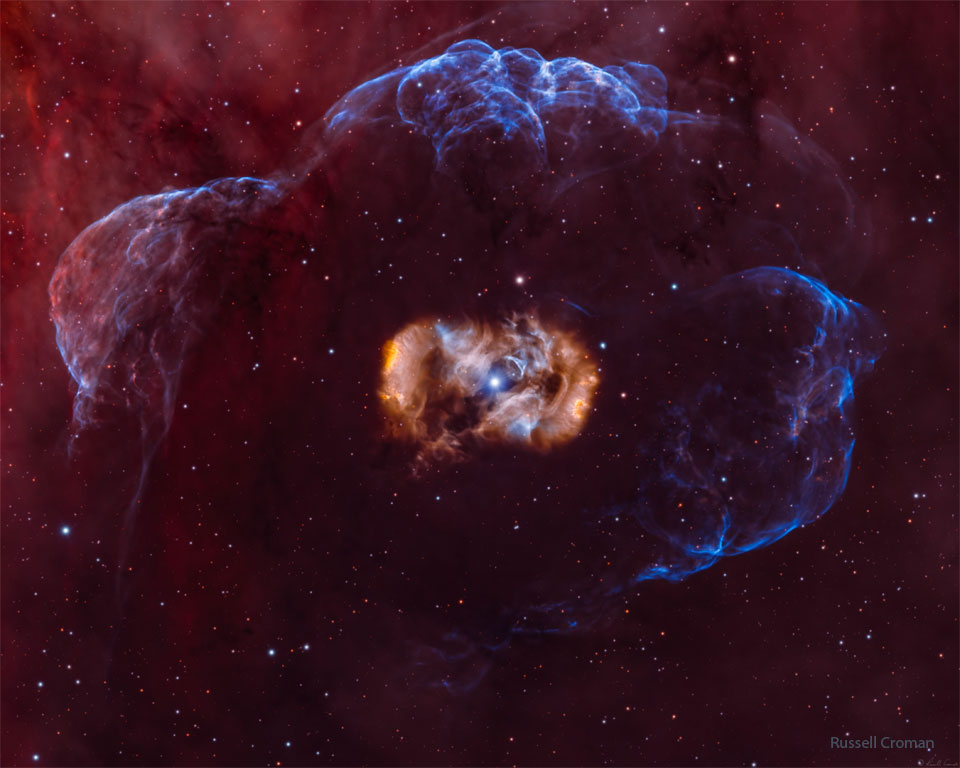
NGC 6164: Dragon’s Egg Nebula and Halo
Image Credit & Copyright: Russell Croman

Music Monday | Suspirium – Thom Yorke

G says this music is boring. Running errands on the weekend, and listening to this album, he asked if we could change it–put something on that wouldn’t put him to sleep. I could not explain how multi-layered the lyrics were to me, how it was anything but boring. I didn’t change the album.

On Sunday, he went for the first bike ride outside since his illness. Before cancer, he used to cycle hundreds of kilometres per week. Ride for hours at a time. Race. The cancer (PCNSL) attached itself to his cerebellum; the part of the brain that is responsible for coordination, balance, language, attention, your nervous system. Damage to it can make it difficult to judge distances, spatial orientation, and can inhibit motor skills and speech. His balance was ok while he was on the bike, he reported, but he did fall off when he tried to stop.

In the first year after treatment, tapering off the steroids caused many of the typical adrenal problems associated with withdrawal; severe fatigue, weakness, body aches, and loss of appetite. The rehab program provided by the occupational therapist of approximately a half hour a day of both muscular resistance exercises and balance exercises left him exhausted. But in this last year, his endurance, stamina and exercise habits have increased. He’s been riding the bike trainer almost every day, walking every other day, and has been more diligent with his balance training. More of that will be required if he wants to remain upright on the bike. I worry that he will break his other hip, or something else, if he falls.

There are so many ways our bodies can betray us. And so many forms of recovery. It seems, we are all recovering from something. So here I am, thinking about our bodies. And what they mean for our salvation.

2023

This is not a diary.

And also, it is.

I barely write in my actual diary; it sits on my side table untouched—because to write would require I feel. And to feel is overwhelming.

Instead, I stare at twelve screens for twelve hours at a time. That is my job.

I do more than stare. The screens are filled with trends and graphs, and pictorial representations of mechanical systems and items of plant. I monitor this plant, operate this plant—pumps, valves, mills, conveyors, a steam-driven turbine, and most importantly, the generator attached to the end of it that makes megawatts of electricity.

And I try not to think about the pandemic.

At work and across the country, people are going about their normal business. The pandemic, which once caused the complete lockdown of Melbourne for many months, has been largely forgotten. People are getting sick, yes. It’s inconvenient, yes. But it’s not stopping most of society from expanding their lives and activities to pre-pandemic levels.

There are only a few, now, for whom life has not returned to normal. And some of those, for whom, a small bubble was their previous life.

I sit at my control panel wearing two N95 masks because we’ve been told that one mask may not offer complete protection. And now that they’re no longer mandatory, I’m the only one wearing one. Two.

Although these may seem like extreme precautions and it would be easier to stay home unless absolutely necessary, I regularly say yes to overtime because I have no other life. I pretend that working so much is why I do not write. I do not write, though, because to write would require I think, and all I can think about is the pandemic.

Editors don’t want stories of the pandemic, anymore. (Did they ever?) We are over them. We do not want to be reminded of all we lost. We are post-pandemic, now, haven’t you heard? But my husband and I are not post-pandemic.

In the most recent edition of my writer’s centre magazine, the non-fiction entry that was runner-up in their competition was a pandemic story. So, I ask myself, are we really over them? Because stories of the pandemic are almost always stories of grief. The pandemic has not ended. And grief won’t end, either.

At the end of this month, it will be two years since my husband completed treatment for a rare and aggressive blood cancer. But then, it seems as if they almost all are. There are over 80 different types of lymphoma alone, one of which—primary central nervous system lymphoma—was his diagnosis. His still severely immunocompromised condition does not allow us to return to normal.

The details, though, are finally beginning to fade. The immediacy with which I can recall specific blood counts, dates of treatment, chemotherapy regimens, and the resulting complications has dissipated. Now, I must look at my calendar to remember everything except the most traumatic of events. Many of the events have blurred. Specifics have evaporated.

During his care, I emptied I don’t know how many bottles of urine in the months he couldn’t walk. I learned how to take obs, administer medication, give injections, connect and disconnect IV bags of fluid to his PICC line/port and other things I thought you needed a nursing education for. I kept meticulous records to provide to the doctors on each hospital admission.

Once, at a late-night emergency admission, after I relayed all the details of his latest treatment, the new symptoms, and the recent blood work results, the on-call haematologist asked me if I was a doctor. I shook my head. I’m not, of course. I just have a background in chemistry, and I sought safety and certainty in the data.

Before his diagnosis, cancer seemed an unlikely intruder. While it would be realistic to describe both of us as middle-aged, we were in general good health, ate a balanced diet, and exercised regularly. And although his mother had experienced breast cancer in her mid-life, she is still with us now, in her late seventies.

For months I blamed myself for giving him cancer. (It doesn’t work like that.) I had asked him to get the tooth implant. (At the beginning of his treatment, someone told me that oral health is linked to your immune system and his cancer is a cancer of the immune system.) Or, I must have given him HIV. (PCNSL is more prevalent in people with HIV—so I made my doctor give me a request for a blood test for HIV serology and was tested. Again. Found negative, again.) I was sure that something I’d done, or not done, had made him sick.

At two years, with no recurrence of the cancer, his chances of long-term survival increase a little. But with cancer, long-term survival is defined as five years. Five years. That’s the amount of time between the birth of a child and their entry into kindergarten. And while that time may seem interminable to new parents, it passes in mere moments. We are now almost halfway there. Relapse occurs in fifty percent of cases within two years. Only thirty percent of affected individuals survive more than five years post-diagnosis. As for anything longer than that? Fifteen to twenty percent of fortunate patients have no recurrence. The average survival after a diagnosis of primary central nervous system lymphoma is three years and eight months. Even my cat is eleven.

Until recently, the fear of his illness returning was safely stored away; buried somewhere in my body while I got on with the business of caring and working. I’ve been able to ignore the thoughts. The feelings. The overwhelm of loss. But the anxiety is starting to pop out in unmanageable ways. I find myself gasping for breath in hallways through blurred vision. Formerly suppressed sobs are forcing my shoulders to shudder, even as I swallow them back down. The constant pain in my chest is not a heart attack. Nor indigestion. Because it gets worse when I think about hospitals.

And so, in 2023 (because there is no time left this year), I have to do the only thing I know that will save me.

I have to think. I have to feel. And, I have to write.

Once Upon A Time

I used to write here almost daily–until, I didn’t; for oh so many reasons.

I became aware that certain people were reading. I became more interested in writing for publication. I became conscious of and conditioned to not write for free.

And yet.

Writing here is, and always was, about more than just me. It was, in so many ways, a conversation.

Blogs are not really the same thing they were in 2010 when I first started. And yes, at some point, I will probably promote my Substack.

But until I commit myself to writing consistently enough to have a Substack, this will have to do. And anyway, it’s the conversation I miss the most. I don’t know if people will comment anymore. I don’t know if that’s the done thing. But I’m back to find out.

Today, a poem appeared in my feed.

WATCHING MY FRIEND PRETEND HER HEART ISN’T BREAKING
by Rosemerry Wahtola Trommer

On Earth, just a teaspoon of neutron star
would weigh six billion tons. Six billion tons.
The equivalent weight of how much railway
it would take to get a third of the way to the sun.
It’s the collective weight of every animal
on earth. Times three.

Six billion tons sounds impossible
until I consider how it is to swallow grief—
just a teaspoon and one might as well have consumed
a neutron star. How dense it is,
how it carries inside it the memory of collapse.
How difficult it is to move then.
How impossible to believe that anything
could lift that weight.

There are many reasons to treat each other
with great tenderness. One is
the sheer miracle that we are here together
on a planet surrounded by dying stars.
One is that we cannot see what
anyone else has swallowed.

This is the original version but it seems, edits have been made. And the below circulates in existence, too.

This is almost the version that Rosemerry reads here…

And, to whomever is reading now: Hello, and welcome.

Richell Prize for Emerging Writers 2021 Longlist

Each year–and every year since 2015–the Emerging Writers Festival has launched the Richell Prize for Emerging Writers, in partnership with Hachette Australia and the Richell family. Last year, mid-pandemic and G’s cancer treatment, I abandoned my intention to enter, and this year, between caring duties and work (and still, a global pandemic), I still almost didn’t. But with five minutes to go before the deadline, I uploaded my documents and hit submit on my entry.

The Richell Prize was established in memory of Hachette Australia’s CEO, Matt Richell, who died suddenly in 2014. The Prize is also supported by Simpson Solicitors in Matt’s memory. It is an incredible opportunity for emerging writers, with a monetary component to the prize ($10,000) and more significantly, for me, a year of mentoring with one of Hachette Australia’s publishers.

I am thrilled to be selected on the longlist this year, and even if this is as far as I go, I am hopeful that my book will one day (soon!) find a home somewhere. Perhaps, even in your home.

Congratulations to all the longlistees/writers/entrants and thank you, to the Emerging Writers Festival, Hachette Australia and the Richell family for this opportunity!

The complete longlist can be found at the link below:-

2021 Richell Prize for Emerging Writers Longlist

Music Monday | The Deepest Sighs, the Frankest Shadows – Gretta Ray (covers Gang of Youths)

Lyrics

Cause not everything means something, honey
So say the unsayable
Say the most human of things
And if everything is temporary
I will bear the unbearable
Terrible triteness of being

Songwriters: David Immanuel Menachem Sasagi Leaupepe
The Deepest Sighs, the Frankest Shadows lyrics © Universal Music Publishing Pty. Ltd.

Virgo Season

It’s Virgo season, baby! And that means, it’s birthday month. Years ago, I started with birthday week–but I’ve now learned to stretch it out, long and slow, over the course of a month instead. Three days ago, my coffee machine died. It was just a small pod machine I purchased in Queensland from the store my ex worked at. It had done well to last nine years with the amount of use it received. But without coffee, I’m not that pleasant to be around. And since I’m off work for a few days and we are in lockdown number seven, G surprised me with one of my birthday presents; a barista machine. As much for his sanity as mine, I suspect. I’m going to have to get up half an hour earlier for work to make my coffee now, but even the almond milk I’ve converted to this year frothed nicely with the steam wand. Happy birthday to me!

What I’m Reading

Lately I’ve been ‘reading’ audiobooks. I started last year, when G was in hospital–there is something deeply comforting about having someone else read to you. In the last couple of weeks I’ve finished Sarah Krasnostein’s The Believer, Nardi Simpson’s Song of the Crocodile and now I’m working my way through Paige Clark’s She is Haunted.

The Believer is a narrative non-fiction of six separate tales expertly woven together through Sarah’s curiosity, non-judgement and her own life. In it she shares how her own beliefs (or lack of) intertwine with these six vastly different people and how we have more similarities than differences even if some people believe in ghosts, UFOs, heaven, and hell. It is a work of compassion and empathy, and, as the back of the book says, The Believer looks at the stories we tell ourselves to deal with the distance between the world as it is, and the world as we’d like it to be. How they can stunt us – or save us.

Song of the Crocodile was both heartbreaking and beautifully written. Nardi’s artful description and incredible story-telling contrasted sharply with the story itself and the pain of race relations between Indigenous and settler/coloniser families in this novel. I don’t read a lot of fiction but this was a stunning debut novel.

She is Haunted is the debut collection of short stories by Paige Clark and while I am only half way in, I’m hooked. Paige’s characters have compelling voices, and the collection features themes of transnational Asian identity, mother-daughter relationships, grief and intergenerational trauma. I will finish this book tomorrow; less than 48 hours from when I started–an extremely rare occurrence for me.

Music Monday | Hero – Mariah Carey

We are still in Lockdown 5.0 in Victoria. I’m not sure how many weeks it’s been now. Two? No. Three? Like I said, I don’t know. So, I’ve reverted to spending hours consuming what I call “wholesome content” to keep me sane: Mostly YouTube–which is as close to a time machine as we have–and Mariah Carey, whose song Hero was released at the end of my sophomore year in high school.

I’ve also been reading, and have just finished The Believers by Sarah Krasnostein, and am now devouring Song of the Crocodile by Nardi Simpson. I’m still reluctant to call it reading, because I’m mostly listening on Audible; I don’t have the ability to sit still to read with so much anxiety coursing through my veins. But I’ve “read” more this year via Audible than in the last three years together, so that’s something.

And for anyone else who also needs a little lockdown pick-me-up, last year, the Phillip Island Penguin Parade was livestreamed during our 112 days of hard lockdown in Melbourne–and they are bringing it back from tomorrow night. The Speed Cubers on Netflix is a documentary about friendship and the fastest rubik’s cubers out there. And added recently to my rabbit-hole (and not on YouTube) is an Irish dancing group called Cairde. Apparently they have a TikTok, but I don’t, so I watch them on Instagram.

We are hoping some of the lockdown restrictions will be eased tomorrow. I’m hoping I’ll get the results of my 7th covid test that I had this afternoon. And, more than anything, I’m hoping they’ll be negative.

Music Monday | Grateful – Rita Ora

Anniversary season is hitting differently than I expected–in a good way. Yes, it is overwhelming to be revisiting all the dates of medical procedures and big information, but overwhelming gratitude has been the predominant feeling.

Today is the one-year anniversary of the day I took G back to hospital to begin the staging scans and assessments prior to treatment. By now, he’d had multiple CT and PET scans, an MRI, and a brain biopsy–which is as risky as it sounds. He had been diagnosed with primary CNS lymphoma, all within ten days of me taking him to the hospital, but it was this week coming that they performed further scans–lumbar punctures, ultrasounds, ocular exams and more PET scans–to confirm with certainty that the cancer was only in his brain and not anywhere else in his body (which would have made it secondary CNS lymphoma).

We are four days out from the anniversary of the commencement of his treatment, fifteen days away from the anniversary of him being placed into a coma, and sixteen days from the night they called me to say his organs were failing.

And yet, here we are. One year later. He is outside, pacing, as he speaks to someone from work on the phone. This is typical; he always preferred to stand and move when having conversations in the before times, and nothing has changed. He is working. Not a lot, just a few hours per week, but working nonetheless. This time last year, we assumed treatment would be a linear process. He would go to hospital, have chemo, it would work (or it wouldn’t) and he’d come home. We did not expect nor account for any of the complications he experienced. By the middle of September last year, we weren’t sure he’d ever work–or walk–again.

And yet, here we are. Grateful is an understatement.

Music Monday | Brand New Sun – Jason Lytle

On Wednesday, it will be the twelve-month anniversary of when I took G to the hospital for strange, stroke-like symptoms that turned out to be brain cancer. The next two months will be filled with dates like these; that time he had brain surgery, the time he came home from chemo but developed a severe septic infection and had to be placed in a coma and his organs started to fail, that time after he woke up from the coma but couldn’t walk or talk or move…

I am not sure how I will process the next few months. I didn’t process any of these events or emotions last year; instead, I woke up every day and simply did the things that needed to be done without thinking about anything else.

Eleven months ago, I took myself to the emergency department for heart issues and chest pain while G was in hospital. The triage nurse took my blood pressure, looked at me and said, “Oh, sorry, it hasn’t worked–let me take it again.”

I asked what it was and she said “It’s 158/123”, which put me in the hypertensive crisis category.

“No, that’s right,” I said, “based on what I’m feeling.”

My ECG was normal, even if my heart rate was elevated. They diagnosed me with stress and suggested a follow up a few months later. That ECG in January was normal, too. But now, even though the stress has dissipated, my heart is still palpitating and thudding a couple of times a day. I still have chest pain, multiple times a day. So I’m typing this with a holter monitor hooked up to my heart. I’ve pressed the button several times for mild pain but I haven’t had a bad episode yet. And I don’t think 24 hours is long enough to register one. A month ago, I’d have had three-four episodes by now. A few weeks ago, the palpitations were so intense I had to pull the car over on the side of the road and wait until they had passed. But now, they’re only happening every few days so I’m sure we won’t record the problem–tests are often ridiculous that way. Unless there is more happening that I don’t actually feel?

So, as we approach what I’m calling “anniversary season”, I am going to focus on sorting out my own health and being grateful that G is still here–currently cancer-free, progressing in rehab, and making just as many terrible jokes as ever. Maybe we’ll get our 40 years together, after all.

You should hold my hand

While everything blows away

And we’ll run

To a brand new sun